Showing posts with label Post-reading Reaction. Show all posts


Pas baca bagian awal, saya pikir buku ini masih di tulis dengan ejaan lama, belum menggunakan Ejaan Yang Disempurnakan (EYD). Ternyata setelah cek informasi buku, kemungkinan besar, tanpa sadar, saya telah membaca Senja Di Djakarta versi bahasa Melayu. Agak kesulitan awalnya. Tapi bahasa yang digunakan mirip seperti cara bertutur orang-orang di Sumatera. Jadi walaupun ada kata-kata dan ejaan yang saya anggap aneh, masih bisa ditebak artinya. Beberapa kata-kata dan ejaan yang digunakan dalam buku ini seperti: Ugama, Wang, Khabar, Kerana, Masaalah, Oplaag (saya tidak paham apa artinya), Fonds, Komunisma (e?), Kapitalisma (e?) dll.


Dari segi alur cerita (plot) juga menarik. Buku ini terdiri dari sembilan bab yang di awali oleh Mulan Mei hingga Januari. Masing-masing bab berkisah tentang tokoh-tokoh dengan latar belakang yang berbeda, sebagai representasi masyarakat di Jakarta. Ada kelompok elit partai, pegawai negeri dan juga kaum terdidik. Sebaliknya, ada kelompok bawah yang berprofesi sebagai pemulung, sopir delman, dan pelacur. Masing-masing bab di akhiri dengan “Lapuran Kota” atau berita reportase yang terjadi dalam bulan itu. Biasanya mengenai kalangan bawah atapun tindakan kriminal.

Tema buku ini juga tidak kalah menarik. Buku ini berlatar di masa-masa awal Indonesia merdeka di era kepemimpinan Sukarno. Buku ini banyak berdialog tentang sistem pemerintahan apa yang layak untuk membangun Indonesia. Menariknya dialog ini terjadi dalam sebuah klub diskusi bulanan diantara kaum elit terdidik. Ada yang merasa bahwa komunisme adalah sistem yang paling cocok untuk Indonesia yang baru saja merdeka dari imperialisme dan kapitalisme. Tetapi tokoh lain menolak, karena negara-negara komunisme yang ada menjunjung tinggi asas otoriterianisme. Ada juga karakter yang beranggapan bahwa Indonesia harusnya menjadi negara yang berasas Islam, karena populasinya mayoritas muslim. Kaum terdidik ini mendapat keritikan pedas dalam buku ini karena hanya menghabiskan waktu menganalisa tanpa bertindak.

Selain menampilkan sebuah diskursi tentang sistem pemerintahan yang layak untuk Indonesia, buku ini juga menggambarkan praktik-partik korupsi, kolusi dan nepotisme (KKN) yang masif dikalangan elit. Disatu sisi kondisi dalam negeri sedang kacau karena persediaan beras, garam dan minyak tanah sedang turun. Disisi lain digambarkan kaum elit memperkaya diri sendiri. Didalam situasi ini, partai komunis memanfaatkan momentum untuk mengumpulkan masa. Akhirnya, terjadi aksi dimana rakyat kecil menuntut haknya, tapi tidak dengan cara yang benar. Bukannya menuntut pemerintah, mereka malah menjarah toko-toko. Asumsi saya, karena partai komunis mempropaganda mereka dengan mangatakan bahwa pedagang adalah kaum proletar yang juga adalah akar masalah.

Ada banyak sekali toko-tokoh dalam buku ini. Semua dengan kompleksitas masing-masing. Hampir semua tokoh tidak ada yang sempurna, bagian yang paling saya sukai dari buku ini, karena menjukkan sisi kemanusiaan di para tokoh. Tokoh-tokoh elit tidak seutuhnya digambarkan sebagai tokoh jahat (villain), begitu juga dengan tokoh-tokoh dari kalangan kecil juga tidak digambarkan sebagai malaikat. Mereka memiliki kekurangannya masing-masing. Tapi tentu, kalangan elit digambarkan lebih jahat. 

Tokoh-tokoh elit: 
  • Raden Kaslan: Salah satu anggoa partai yang melakukan praktik korupsi, kolusi dan nepotisme (KKN)
  • Suryono: Anak Raden Kaslan yang baru kembali ke Indonesia setelah dinas di Kedutaan Besar Indonesian di New York. Suryono memiliki hubungan terlarang dengan Fatima, istri muda ayahnya.
  • Halim: wartawan yang menggunakan korannya untuk mendukung eksitensi partai. Tokoh Halim digambarkan sebagai tokoh oportunis yang sebenarnya menolong partai hanya untuk mendapatkan uang saja. 
  • Ada beberapa tokoh lain seperti petinggi partai partai, namun mereka hanya berfungsi untuk menggambarkan kerusakan moral dikalangan petinggi negeri saat itu.
Tokoh intelektual: 
  • Pranoto: bertindak seperti ketua dari klub perkempulan para intelektual muda. Memiliki hubungan dengan seorang wanita Amerika. Namun, cinta mereka tidak bisa dilangsungkan karena dinamika dalam negeri saat itu sangat anti-asing. 
  • Ahmad: memiliki ideologi kiri (komunis) dan menginginkan Indonesia untuk menjadi negara komunis. Diakhir cerita Ahmad menjadi provokator agar orang-orang kecil bertindak anarkis terhadap kaum proliter, termasuk pengusaha kelongtong. 
  • Yasrin: Awalnya berpandangan liberal, tetapi di akhir cerita menjadi pengikut partai komunis. Dia seorang penulis yang awalnya bekerja dengan Pranoto dengan upah sangat kecil. Setelah menjadi anggota partai komunis, dia menjadi redaktur majalah rakyat dan digaji 1000 rupiah. 
  • Nurhalim: Anggota klub yang memiliki pandangan islamis dan menginginkan Indonesia menjadi negara Islam. 
  • Ies: Satu-satunya tokoh peremuan dalam klub ini. Dia tidak memiliki pandangan idelogis yang jelas. Tetapi sepanjang cerita dia konsisten menginginkan yang terbaik untuk kaum bawah. 
  • Suryono: Liberal, pencinta hal-hal yang berbau Barat. Dia juga mengaku menganut eksistensialist. Setiap orang bertanggung jawab atas dirinya masing-masing. Tapi, dia tidak punya pendirian kuat dan tidak terlalu perduli dengan sekitar. Dia hanya memikirkan diri sendiri saja. Cukup hedonis juga, gaya hidupnya. 
Kaum bawahan: 
  • Item: Datang dari kampung mengadung nasip di Jakarta jadi pemulung. Sering kelaparan dan ngutang di warung 
  • Saimun: Teman Item yang memiliki nasib yang sama. Hanya saja Saimun lebih optimis dalam hidup. Dia juga lebih gigih bekerja dan memperbaiki hidup. Keduanya buta huruf. tapi cuma Saimun yang betekad untuk belajar membaca. Item sudah pasrah. 
  • Neneng: Awalnya tinggal di pondok yang sama dengan Item dan Saimun, tapi akhirnya jadi pelacur. Diakhir cerita dia ditangkap polisi, tapi ditangguhkan oleh Saimun.
  • Ada tokoh-tokoh lain seperti supir delman dan keluarganya juga dengan nasib yang sama. Fungsinya dalam novel ini untuk menggambarkan kontras antar ketiga kelompok. 

Sisi lain yang saya sukai dari buku ini, nilai rupiah masih tinggi :D. Harga mobil masing 500 rupiah. Harga rumah masih 1000 rupiah. Sudahkah waktunya kita meredenominasi rupiah?

Secara keseluruhan, buku ini sangat bagus dan saya merekomendasikan semua orang diatas 18 tahun untuk membaca!
Get it on Apple Books


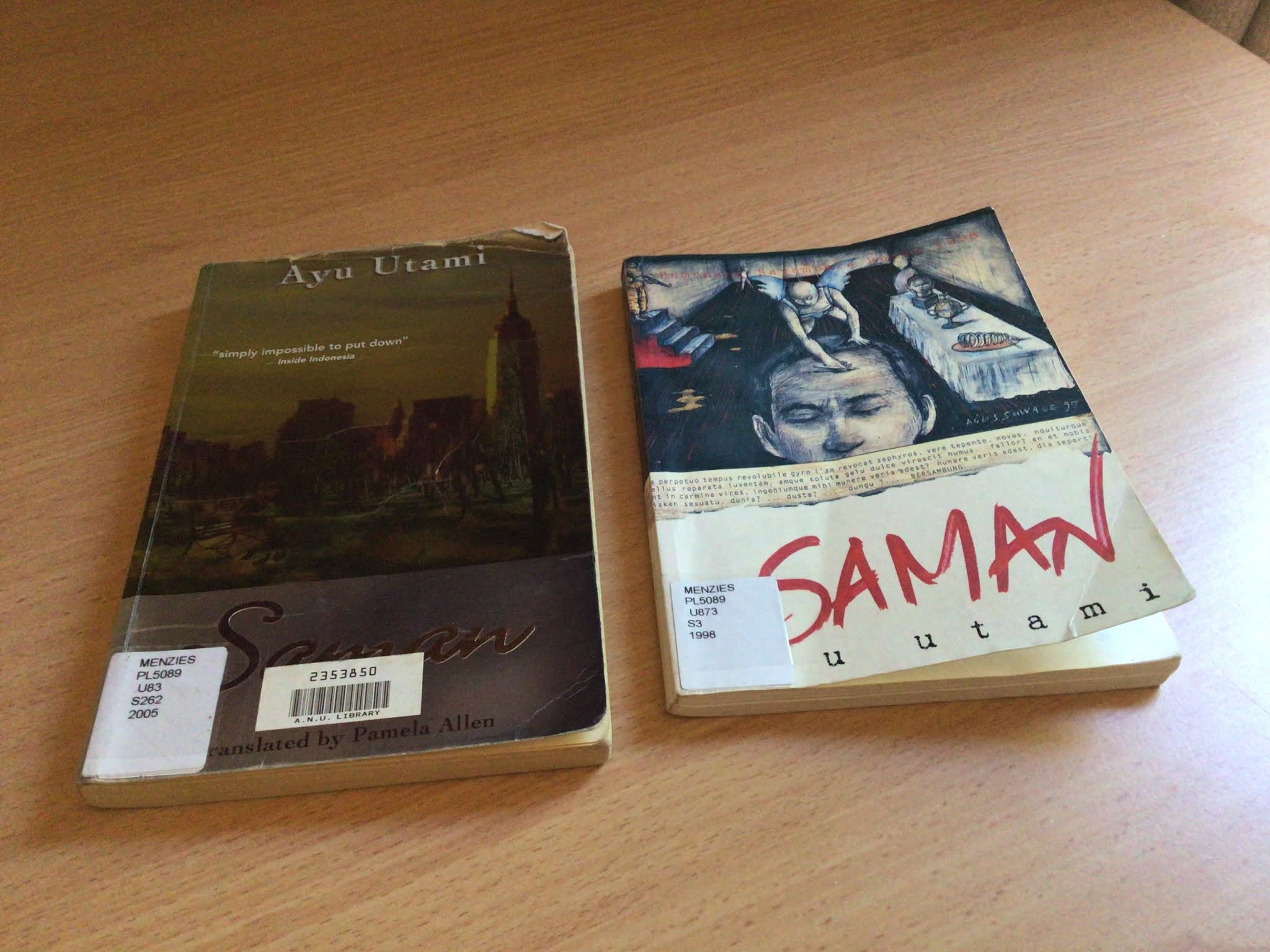
Saman adalah karya pertama Ayu Utami yang saya baca. Sebelumnya saya sudah mengenal Ayu Utami dan saya juga cukup sering mengikuti kegiatan beliau di teater Utan Kayu dan Komunitas Salihara, walaupun hanya melalui internet. 


First impression saya terhadap buku ini adalah sangat genius dan beautifully messy. Buku ini mendobrak hampir semua sisi proses menulis, baik dari segi plot, narasi dan tema. Hampir tidak ada satu sisi pun yang konvensional dari buku ini. Menurut ini adalah sebuah terobosan. Ketika biasanya kita membaca buku yang sangat linear dan diceritakan oleh satu pencerita (narrator) saja, disini kita mendapatkan gaya bercerita yang sangat acak dan memiliki pencerita yang banyak.


Pertama, dari sisi plot. Cerita bermula di masa kini. Namun sepanjang buku, cerita bolak balik dari masa kini ke masa lalu dan kembali ke masa kini lagi. Ini bukan metode yang baru. Penulis lain sudah pernah menerapkan metode ini. Selain Ayu Utama, karya penulis lain yang pernah saya baca menggunkan metode penulisan seperti ini adalah Elif Shafak dengan karyanya seperti The Forty Rules of Love, Honour dan the Bastard of Istanbul. Saya sangat merekomendasi kalian untuk membaca karya-karya Elif Shafak! 


Kedua, sis pencerita (narrator). Keseluruhan isi cerita berasal dari banyak sumber dengan metode penyampaian yang berbeda-beda. Sumber pertama ada Laila yang membuka cerita di awal buku dengan setting di Central Park, New York. Lalu cerita dilanjutkan oleh orang ketiga, namun diselingi oleh alam bawah sadar Laila yang muncul tiba-tiba memotong cerita si orang ketiga. Terakhir, ada korespondensi antara Saman dan Yasmin. 


Dengan metode bercerita seperti ini, pembaca akhirnya menjadi spektator yang aktif. Dari pada menikmati cerita saja, pembaca juga berkesempatan untuk berperan aktif dalam menyambungkan cerita yang sangat acak adut. Seperti kegiatan detektif yang seru. Connect the dot.


Ketiga, tema. Buku ini tidak memiliki tema tunggal. Melainkan banyak tema atau didalam teori sastra sering disebut sebagai metanarrative. Adapun beberapa tema yang diangkat seperti: 
  • Cinta terlarang antara Laila dan Sihar, serta Saman dan Laila. 
  • Penindasan kaum termarginalkan seperti Upi gadis yang mengindap gangguan jiwa dan orang-orang Prabumulih yang di tindas oleh pemerintah dan pengusaha pertanian. 
  • Nilai-nilai moral Barat versus Timur. Laila dan tokoh-tokoh lain didalam buku ini selalu mempertanyakan esensi dari moralitas yang notabene adalah konstruksi sosial. 
  • Seksualitas, terutama antara laki-laki dan perempuan. Bagaimana nilai moral merugikan dan mengutuk perempuan sebagai kambing hitam dalam setiap perkara seks. Padahal laki-laki juga ikut andil didalamnya. 
  • Hak Asasi Manusia. Didalam buku ini, tokoh Saman memperjuangkan hak orang-orang Prabumulih yang tertindas. Namun pada akhirnya rezim yang ada juga meng-opresi hak asasi dia. Pada akhirnya ia harus berlari ke Amerika. 
  • Spritualisme. Tokoh Saman pada awalnya adalah seorang pastur. Namun karena keterlibatannya dengan pihak otoritas dalam membantu orang yang tertindas akhirnya dikeluarkan oleh pihak gereja. Setelah menyaksikan penindasan terhadap orang-orang di Prabumulih, Saman akhirnya mengalami krisis eksistensialisme. Dia mempertanyakan keberadaan tuhan yang tidak hadir dalam membantu orang yang tertindas. 
  • Perlu diketahui, Ayu Utami menciptakan sebuah terobosan berpikir yang dia sebut spriritualisme kritis. Pemikiran ini juga ia sematkan dalam buku-bukunya. Saman ini adalah salah satu karya sastra dengan tema spritualisme kritis. 

Terakhir, setting. Cerita ini tidak ber-setting tunggal. Melainkan, cerita ini bertemapat dibanyak lokasi. Pertama, ada New York dimana Laila berjanji bertemu dengan Sihar. Lalu ada lokasi tambang minyak di Laut Cina Selatan. Terkahir ada Prabumilih, Sumatera Selatan. Ada juga lokasi-lokasi yang tidak terlalu signifikan seperti Medan dan Jakarta. 


Sekilas membaca buku ini mengingatkan saya pada karya-karya Jeannette Winterson seperti Sexing the Cherry dan Oranges are Not the Only Fruit. Terutama karena buku ini mengangkat elemen-element dongeng dan biblical story. Yang membedakan, dalam novel Saman ini ada unsur khas Indonesia seperti mistis dan pewayangan. 


Secara keseluruhan, membaca Saman adalah sebuah kegitan gimnastik intelektual yang sangat asik. Sebagai pembaca, kita tidak pernah tau kemana cerita akan berujung. Bahkan kita tidak pernah tau gerangan siapa yang akan bercerita. Yang paling menarik, keseluruhan isi cerita tidak linear. Sehingga pembaca harus aktif berpartisipasi dalam menyambungkan benang merah cerita. Dengan begitu pembaca bukan spektator pasif, melain spektator aktif.  


The first book of Buru Quartet ends with the death of Mr Mallema and the repercussions it brings to the family. The court decided that the Mellema’s estate and wealth would be divided into three: Robert, Annelies and Mr. Mallema’s son from his legal marriage, Engineer Maurits Mallema. Nyai Ontosoroh, who has been looking after the business since Mr. Mallema was incapacitated, did not get anything at all. While that alone has intensified the situation, what made the situation even more tense is Robert’s disappearance. If Robert was around, the court would have appointed him as Annelies’s guardian. However, since Robert was nowhere to be found, Annelies was then forcefully sent to the Netherlands to her legal guardian, the Mellema family. 


The thing that needs to be noted, however, is that Annelies has got married with Minke months before. However, since Annelies was still considered underage, the European court did not acknowledge their marriage. A series of defence were made both at court and through newspapers, but to no avail. One of the arguments used was that the marriage was legal in the Islamic law. If the court did not acknowledge this marriage, it meant that the court disregards Islamic law. This argument was successful to get the natives’ attention. However, it did not succeed to change the court’s decision. 


In the Child of All Nations, the story picks up from when Annelies was on a ship sailing for Europe. Obviously, considering how weak Annelies has always been, this whole experience has deteriorated her health even more. Before the sail, she was unconscious for days and now even though she is conscious she  is  barely alive. 


Both Minke and Nyai Ontosoroh wanted to accompany Annelies leaving for Europe, but the court disapproved it. Rather, they both were under house arrest during Annelies’s departure. Only three days after Annelies left that they were freed. 


Luckily, Nyai Ontosoroh has secretly arranged Robert Jan Daperste alias Panji Darman, a loyal friend of the family, to be on the ship along with Annalies. It is he then who reported to the family about Annelies’ situation on the ship and in the Netherlands. From his letter to Minke we learn that Annelies was getting worse and she did not want to eat and lost hope entirely.  From his letter, we also learn that when the ship arrived in the Netherlands, none of the Hellema’s family was present to welcome Annelies. Instead, an old woman was paid by the family to pick her up. Panji Darman then followed the old woman who turned out taking Annelies to her own house, not the Hellema’s house. It became clear that the Hellema’s family would not take care of Annelies. After a few weeks, a telegram from Panji Darma arrived informing that Annelies has passed away. 


Personally, I was very disappointed on this part. Here I was thinking that this journey, being away from Nyai Ontosoroh, would make Annelies a strong independent woman. No, instead, she is dead. Such a turn off. On the bright side, Pram kills her early in the book. Again, it shows that Pram considers her character just as a foil baring no significance to the story whatsoever. Once she is dead, Pram continues with more important issues. 


The first important issue is about empowering the natives. This theme was brought up through the Khouw Ah Soe’s character who is a member of Chinese Young Generation Movement who came to the Dutch East Indies illegally. He was in contact with Minke because Minke was appointed by a newspaper to write a story on him. However, Minke was disappointed that the newspaper did not publish what he originally wrote. Instead, they completely fabricated an entirely different story which Minke found to be misleading. Luckily, Khouw Ah Soe believed Minke and they became friends. From him, Minke learned that there is a movement in China wishing to develop the country so that they can become equal with that of the Europeans. 


The second important thing in the second book is about Japan’s rise in the late 19th century. Because of its significant growth, Japanese people became the first non-white whose status were made equal to the white people before the law. The Japanese was also an inspiration to Khouw Ah Soe in his activism. He wanted the Chinese people to aspire to do the same as the Japanese. However, Japan was also beginning to invade parts of Korea and China. In this regards, the book also talks about international relations of the late 19th century. The book talks about how balance of power politics was about to take place. Obviously, this is a foreshadowing for Japan’s eventual power and greed to invade the entire South East Asia. 


The third theme being discussed in the book is identity crisis that Minke was experiencing. Being educated in a European school has made Minke views the world around him with the European lens. As a result, when he sees local customs and people, he can’t help but looks down on them. Increasingly, however, Minke begins to see that European people with their so called “enlightenment” are savage in their own ways. Minke’s experience with the law is one of the examples in which Minke sees that Europeans shield their savageness under bureaucracy and law. But beneath all of them lies deception and exploitation. 


Minke’s identity crisis doubles when his European friends encourage him to write in Malay. They assert that Minke should write in a language that the natives understand, that way the natives can benefit from Minke’s wisdom. They also said that Minke does not owe the Europeans anything. All these times Minke has been writing in Dutch and is comfortable to do so. Meanwhile, Minke as an educated native owes his people everything.  Hearing what his friend had to say, Minke was defensive and offended at times. But as time goes, he understood why they thought so. But we are yet to see Minke writes in Malay. 


Another important event in the second book was Robert’s letter informing where he is. Before he disappeared we knew that he had fallen into Babah Ah Kong’s trap, just like his father was. He entered Bahah Ah Kong’s brothel and slept with a Japanese prostitute who had syphilis. Now on his letter we learn that he lived abroad in Hong Kong and is sick. In his final letter we learn that he is in Los Angeles being treated in a hospital. He also admitted to have impregnated a maid named Minem and asked Nyai Ontosoroh to acknowledge him. However it is so strange that Minem did not catch syphilis, considering they slept after Robert slept with the prostitute who had syphilis. And by the way, Robert died too. 


Towards the end of the book, Nyai Ontosoroh and Minke expected Muraits Melemma to arrive and they also expected that he would take over the entire estate. Throughout the book he has been portrayed as an antagonist whose only motive is to take over the Mellema’s wealth. And at the end of the book, Nyai Ontosoroh, Minke, and their two other European friends confronted him for his behaviour, questioned his Christian and European morality. He was mostly quiet the entire confrontation and was forced to leave because many natives had gathered in front of the house hearing May crying and shouting on hearing that Annelies had died. Yes, Nyai Ontosoroh and Minke did not annouce Annelies’ death. Even their close friends did not know about it. Only when Maurits was present that they called him out for his cruelty and blamed him as Annelies’ murderer. And this is where the second book ends. So, we don’t really know if he did take the Mellema’s wealth after all. 


See you in book 3. 


Adhari's bookshelf: just-finished

Child of All Nations
it was amazing
The first book of Buru Quartet ends with the death of Mr Mallema and the repercussions it brings to the family. The court decided that the Mellema’s estate and wealth would be divided into three: Robert, Annelies and Mr. Mallema’s son...
tagged: buru-quartet-marathon and just-finished

goodreads.com


This Earth of Mankind is the first book of the Buru Quartet series, and probably the most famous of the four. Although, personally, I don’t find the first book exceptional at all compared to the other three. In fact, I find the love story between Minke and Annelies quite shallow. But, isn’t all love stories are? 


The story starts with the narrator introducing himself. However, rather than revealing his real name, he let readers know the name people use to call him: Minke. At first, readers are puzzled with name especially because Minke claims to be a native, but the name Minke is not a common native name at all.  Luckily, there is one special chapter in which Minke explains how the name comes about. It turns out that the name was born at a time when his teacher was angry at him for not being able to answer a question he asked. The teacher meant to say MONKEY, but realising that it’s inappropriate to insult a student in a class before other students, he then quickly changed it into Minke. So, Minke is actually a derogative term, but only later that he understood that. 


Minke was among the only two natives who were privileged to have been enrolled in Surabaya Hoger Burger School (HBS) or the equivalent of Senior High School. The other one was Robert Jan Dapperste who was admitted because he was adopted by a Dutch preacher. Likewise, Minke, too, was admitted because he was the grandson of a Bupati (regent). Indeed, during the colonial time, no natives are given access to education, unless they are the children of important people. 


A bit of context, the book begins in 1898. By this time, the Dutch had ruled Indonesia for over 200 years. This quartet, therefore, is a great historical fiction to show Indonesia’s colonial history. We get see how the natives were being treated by the Dutch colonialist. Most important of all, we get to see how big a failure the Dutch had been in influencing Indonesia culturally. It appears that unlike other colonial doctrine that believed colonialism was a way to enlighten the so called “savages”, the Dutch’s only goal was to exploit the resources and the native people for their own benefit.  


The Dutch’s biggest failure for me is the fact that the Dutch did not introduce education to the Indonesian native, or if did it was obviously failed. What is apparent is that Indonesian people had to fight for it. It is no surprise that after ruling Indonesia for 250 years, no trace of Dutch language left in Indonesia. Unlike the former British colonies, they all adopt the English language either as their official language or as their second language. This is not to say that British colonialism was better than the Dutch. No. No form of colonialism is justified. 


Back to the book. At the surface, the story seems to centre around a love story between Minke and an Indo girl, Annalies. An Indo is a term used to refer to Dutch-Indonesian mixed person. But, as we dig deeper, it is obvious that Toer, or Pram as Indonesians fondly call him, only uses  the love story as a foil to talk about issues that are much deeper and much more serious such as colonialism, segregation, slavery, psychology, capitalism, feminism and many more. 


The lead character of the book is obviously Nyai Ontosoroh. Nyais are an important part of Indonesian colonial history, beautiful native women bought by colonial officials to be their concubine. These women were often ridiculed and outcasted by other natives. But, as Nyai Ontosoroh’s story, they are victims of the circumstances. 


We are introduced to Nyai Ontosoroh as Minke and his schoolmate, Robert Suuroof, was visiting the Hellema’s estate. As Minke was smitten by Annalies’s beauty, readers were smitten by Nyai Ontosoroh’s unusual charm. A nyai has the reputation for being a sex slave. However, nyai Ontosoroh is different. She is fluent in Dutch and she is literate. Later, we also discover that she manages the entire Hellema’s business empire - something that’s quite extraordinary for a native woman to do at the time. Probably her most powerful charm is her progressive way of looking at the world. Although she is a nyai, she doesn’t look down at Minke. Rather, she welcomes him and does not pay attention to his nativeness.   


The love story between the two continues, but it terms of storyline we know that it is so just to draw Minke closer to nyai Ontosoroh and the Mellema family who will take the story to a whole other level. Personally, I don’t like how Pram portrays Annelies’ character. He describes her as a beauty beyond compared, but she is very fragile and sentimental. This is quite contradictory, considering that she started working with her mother quite early on. My point is that, you can’t be mature but immature at the same time. I suspect that Annelies’ character is not important at all. She is just there as a foil so that we get to see more of nyai Ontosoroh. 


Ontosoroh was made into a nyai when she was quite young. It was her father who sold her to a colonial official (Tuan Besar Kuasa), Mr Mellema, so that he could be promoted into a higher position. Because of this, she holds a grudge against his family. She refused to acknowledge them and to meet them ever since. At first, Mr Mellema was a nice gentleman teaching Ontosoroh everything from hygiene, reading, writing and even managing a business. It was Mr Mellema therefore who transforms Ontosoroh into a “modern women”.


However, Mr Mellema stops being a gentlemen (at least according to nyai Ontosoroh) after one day a man came to their estate which turns out to be his son from his legal marriage back in the Netherlands. That man confront Mr Mellema for deserting him and his mother. Ever since that day Mr Mellema no longer the person he used to be. Later in the story we learn that he has been staying at a brothel next door and spends his time drinking. Amidst all of this, nyai Ontosoroh takes over the job in managing the estate and the businesses. That’s how she becomes a truly independent business woman. 


Minke was invited to stay with the Millemas but he did not know how to react. After a long consideration and because Annelies was madly in love with him to the point that she would get sick just being away from him (I hate this part), he finally gave in. However, little that he knew this is the beginning of all troubles that he is about to encounter. What are those troubles? I think this is the part where I should leave you. Please get the book and read it. It’s so worth it. 


What can you expect from the book?  

  1. You get to see life during the colonial time. You get to also see the narrator’s perspective about native’s responses to colonialism. For example, we are given two contrasting responses to colonialism. One, that of the the Javanese, who gives in to the colonial regime. More exactly, the Javanese rules, who cared only about themselves. So long as they are safe, they do not think about the common people. While the kings and sultans kept their place, the common people suffered. Meanwhile, we also see how the Acehnese responded to colonialism. They fought and fought even though they knew they would fail. Regardless, they have the courage to fight. It had proven that the Dutch spent the most money in this war, an evident that Acehnese was not easy to defeat.


This post, above anything else, is a confession post. The confession: I haven’t read much lately. Well, I do read, but what I read are just a bunch of academic journal articles assigned by my course conveners and news. Those don’t count, right? 


I have no excuse for all of this. I could have read more, especially since the pandemic everyone has been forced to stay at home. Except, I had to work on my assignments during the semester. 


Now that I am on summer break, I really run out of excuses. I guess, I better catch up of my reading. 


Lucky for me, a couple months ago an angel gave away a bag full of Pramudya Ananta Toer’s books on Buy Nothing of my suburb. Not wanting to miss the opportunity, I immediately put my hands up, and like an angel, or perhaps Santa is the most appropriate name for the occasion, she gave all of them to me. Within the bag includes the complete edition of Buru Quartet and other books such as: It’s Not An All Night Fair, Fugitive and Arok of Java. If any gift can make me happy, it has to be books. 


I have started the marathon. So far I have finished reading the first and second books. The point of this post is to document my experience while reading this masterpiece. I will write down my feeling and reaction while reading each book. 


I am fully aware that Pram is a a big name in Indonesia and almost everyone says that his books are not that easy to absorb. Implying that it requires certain level of intelligent to understand his works. Well, it’s true to some extent. But I think the problem lies in the language. Indonesian language is always changing and the new generations are not familiar with the “old” generation of Indonesian language. The old version strikes them a bit stiff and too formal. So yes, it requires a bit of effort both to understand the language and the content. 


Luckily for me, the book that I got are all in English and so far I have no problem at all. Except, there are parts that I find funny. I am not a translator, but I did take translation course back in the days. And, one of the thing the translation course emphasises is that we need to contextualise everything. We cannot translate everything literally. There is one particular character in the book named Minah who has “slut-ish” personality. In Indonesian language, we refer to such character as cewek gatel, which literally translates into an itchy girl. Rather than calling her a slut, Max Lane chooses to use “itchy girl”. There must be an intention behind it which I am still figuring it out. 


So yes, in the next posts I will be documenting my whole experience reading each book. I am so excited! 


Adhari's bookshelf: buru-quartet-marathon

This Earth of Mankind
really liked it
tagged: buru-quartet-marathon
Child of All Nations
it was amazing
tagged: buru-quartet-marathon
Footsteps
tagged: buru-quartet-marathon
House of Glass
tagged: to-read and buru-quartet-marathon

goodreads.com


I have just finished reading Christopher Wylie's "Mindfuck: Cambridge Analytica and the Plot to Break America". If you don't know who Christopher Wylie is - he is one of the Cambridge Analytica's whistleblowers (the other one is Britany Kaiser). In case you are not familiar with Cambridge Analytica scandal, perhaps you have heard about the Brexit and Donald Trump? It turns out that there is a link between the two. Both Brexit and Donald Trump are the results of psychological warfare used by Cambridge Analytica to influence people's psychology so that they would vote for certain candidate or certain outcome. This is of course is not a new tactic. What's new is the use of sophisticated technology and illegal data harvesting from Facebook and other online flatforms to accurately determine people's personality. As it turns out, it is easier to convince you when you are told what you want to hear, instead of the real facts. That's exactly what Cambridge Analytica did. They mapped people who were vulnerable (gullible) and fed them with disinformation about issues (hidden darkness) that they potentially care about or secretly care about such as job or immigration.  


This book is simply great. It delves deep into more than just talking about the chronology of how the whole shitshow happened. Instead, it also talks about culture, social issue and philosophy, if you like. Wylie's good story telling skill certainly helps to make the story even more interesting. When I read it I can't help but feel like the whole thing is a sci-fi story exists in Christopher Nolan's movies. But obviously it is real and that makes it even more scary.


Courtesy of https://www.meetup.com/DC-International-Affairs-Book-Club/events/266930092/


One of the themes addressed in this book is about how tech company has emerged as the new empire. Wylie repeatedly talks about how tech company like Facebook has acted as if it is a nation. If fact, according to the book, tech company has more power than a nation. While a country has to have a warrant that involves a complicated bureaucracy to investigate a case, tech company can just go and investigate the case in question. No warrant necessary. This happened during the early days of Cambridge Analytica's investigation. Facebook investigated Cambridge Analytica before law enforcement in the UK was even able to get their hands on the case.


The question then is to what extent tech companies or private entities have the power to do what they do? Should our law draw a clear line on what is okay and what is not okay? As we have recently learned - our law does not have that clear line yet. Because of it people's online engagements (data) are harvested freely. We are creepily watched by the big brother of the tech company. If they just passively watch, it would not be a big problem. They watch and learn about our personality. With that knowledge they become the mastermind behind every of our decisions. They feed us with advertisement, news, hobbies that will tempt us into buying the product that we don't need and doing things that are harmful to our democracy. In the case of election, they feed us with issues sensitive to our psychology, so that we would vote for a certain candidate. We no longer have our free will. We are puppets of the modern technology.


As such, it is pressing to question whether tech company is the new empire. Our world order cares so much about democracy and human rights. The irony is both of these elements are being eroded by the new technology. The use of algorithm puts people in the bubble of their "looks-alike" and people are psychologically manipulated to think and feel in certain ways.


In the book, Wylie describes Alexander Nix as a colonial figure who uses SCL (Cambridge Analytica) to fetishize about Britain's past colonialism. Perhaps what Cambridge Analytica did is a new colonialism? Cambridge Analytica, a UK-based company - meddles in foreign election (particularly in British former colonies) and uses propaganda to divide people in those countries. Isn't that the very tactic British Empire used in its heyday? Divide and conquer! It is the divide and conquer tactic that has become the roots of all disasters that are occurring in the world today. Look at India - Pakistan conflict. Look at Palestine - Israel conflict. So perhaps tech company is the new empire? Perhaps colonialism has evolved. It is no longer about territorial annexation, perhaps data is the new thing to colonize? Why not? You can divide people through that data. When people hate one another, they fight against one other, more chaos and more destruction.


The UN charter bans any form of colonialism. Should we ban the colonialization of data? Should we ensure that internet users are given the rights to self-determination? Should sovereignty over the content of our internet feeds be made a thing? I think, yes! They should. 


Coincidentally, my courses this semester were about imperialism and human rights. In fact, my final assignments were literally about those two things. I wish I had read this book sooner, I could have talked about tech company's emergence as the new empire, as opposed to the slowly and painfully dying American imperialism (the one that I ended writing). Similarly, in my other assignment I could have talked about how imperative it is for the rights to digital privacy to be included in the Universal Declaration of Human Rights. Instead I talked about how human rights should be treated as a dynamic concept rather than a rigid one. Well . . . I did write about this topic before in the Pre Departure Workshops, but I am not confident that it was any good. But I am really interested about this topic and really look forward to being engaged in it more in the future. Hopefully, my 2nd semester courses will allow me to learn more about this issue! 


Adhari's non-fiction book montage

Educated
Becoming
Utopia for Realists: How We Can Build the Ideal World
The Righteous Mind: Why Good People Are Divided by Politics and Religion
Grit
Mindf*ck: Cambridge Analytica and the Plot to Break America
Why We're Polarized


Adhari Abroader's favorite books »


As an English graduate, my exposure to non-fictions was only through journal articles that I had to read for writing papers (If you can count journal articles as non-fiction at all). I used to think that people are incapable of 100% not being bias. Hmm . . . I think I am still holding on to this thought.


I was always suspicious with books that are classified as non-fictions. I believed that there had to be some elements of fiction in them - whether the writer exaggerates or understates the events, views and etc.


Also, I admit that I was clouded by my judgement. When I heard non-fiction, I tend to associate it with self-help books. I don't know why. I don't have a logical explanation to that. And what's the problem with self-help books? They just simply don't work on me. Or, maybe I just have not found the right ones. I feel like I am at an age where preaching does not work anymore. I like conversation better.


Lately, though, since I started my master in International Relations, I have been trying to read non-fictions more (particularly the ones that are connected to IR or Politics). And . . . I have to admit that there are actually quite good non-fiction books, like really really good ones. And, I don't only read politics, but I have been also trying to read biography and even self-help book.


The moral of the story is . . . Don't say no to something that you have not tried.


But I guess there is an explanation to my shifted perception. Although in my undergrad we talked a lot about social issues, politics and psychology - we did it in connection with literary works. So the focus was to decode the literary works and to better understand the social phenomena of certain time periods through that literary works. Now, however, we talk about all those subjects not only to understand them but also to find ways to potentially change them through the means of politics and policies. In other words, because the focus of my learning environment has shifted, so does my interests. I no longer just refer to fictional works to talk about social issues - instead, by reading non-fiction books I will be able to refer to real historical events.


I guess what I am trying to say is that - I have been trying to be open-minded about books. I am trying to not compartmentalise my reading based on my bias perception about certain genres. And . . . As I have recently learned, fiction or non-fiction do not matter much. What's more important is whether the writing resonates or challenges your perception in a constructive fashion. If it does, then none of it really matters.


At this point, I have not read non-fictions that much. But I look forward to reading them in the future.

These are non-fiction books that have changed my mind about the genre.


  1. Educated by Tara Westover
  2. Becoming by Michele Obama
  3. The Righteous Mind by Jonathan Haidt
  4. Utopia for Realists by Rutger Bregman
  5. Grit by Angela Duckworth
  6. Mindfuck: Cambridge Analytica and the Plot to Break America by Christopher Wylie  (Currently Reading)
  7. Why We're Polarized by Ezra Klein (Will read it once I am finished with Mindfuck)


If you have any recommendation, please leave it the comment!


Courtesy of https://www.mercurynews.com/2017/11/02/amazon-books-opens-first-east-bay-outpost-in-broadway-plaza/


I vaguely learned about Grit in my very brief career as a teacher (2017-2018). In the school where I used to teach, it had a very unique culture where every teaching staff (at least in the English department) took turn to do a microteaching in the first 10 minutes of our department's weekly meeting. In a way, the microteaching was an opening to the meeting (the main star). To avoid making any mundaneness, everyone was free to pick any topic and it doesn't have to link to our teaching material.


One particular week, it was our department manager's turn to do the microteaching. What she brought us in her microteaching was Duckworth's Grit. I was completely hooked by the concept of Grit and determined that I will get a copy of the book and read it. Unfortunately, being a teacher was very handful. I had to teach roughly 20 hours a week. The teaching itself was fun. What I had issue with was making elaborate lesson plans. I found this to be a waste of time. I felt like a simple syllabus is more than sufficient to ensure that you are well guided. My point is, why should teachers spend so much time writing long narratives on things they plan to do in the class, when actually they could use the time to prepare for their classes. Let's face it, lesson plan is not a preparation for the class. Especially in this era of technology, you have to prepare presentations and visuals that will capture students' attention. So, if I had an authority, I would let teachers spend more times preparing on how to make their classes interesting, instead of preparing on how to make lesson plans about them.


Anyway, I didn't get to read the book then. Luckily I just finished reading the book last night. I know it took me 2 years, but the book is no less relevant to me now than it was. 

Having finished the book, now I have much more clearer idea on what my department manager aimed to say then. She wanted to say that: yes, teaching is not an easy job; yes, not all students will understand what you teach; and yes, smart students are great, but grit students are greater. I think if I had read this book then, I would have had a better understanding on how to: a, motivate myself and b, to motivate / teach my students. I admit that although I had an amazing one full year teaching experience, I cannot claim that I was a great teacher. After all, I did not have a teaching degree. I did not study "psychology for teachers", which I think is an important knowledge for professional teachers out there. In other words, I might have done "not very teacher like" things during my year teaching experience, but I did it because I did not know better. It was my first time teaching after all. It was my first real job.


While this book could have helped me then, it is obviously helping me now. The concept of grit (determination and perseverance) is a key to getting through hardship and possibly achieve greatness.


As someone who switches career a lot in the past two years, I find this book to be an answer to all my angst and anxiety. This book helps me understand what's going on deep inside my twisted mind (LOL)


Although this book may seem like a self-help book, I think it also tackles a lot of other issues that parents and teachers could benefit from.


For An Individual 


There is one chapter in the book that makes a clear distinction between three people in the world. One, a person with a job. Two, a person with a career. And three, a person with a calling. The person with a job works only to survive (just like breathing and eating). Meanwhile, the person with a career works to elevate his career (how to get to the top). Finally, the person with a calling works to fulfill a duty that benefits people around him (beyond himself).  


I find these three distinctions quite powerful and it gets me question which one does my personality fit with the most.


courtesy of mariliza.com


For Parents


Being a parent is not an easy task. Most parents don't know what they are doing. But I think what parents can do is read what scientists have studied about parenting and try to experiment with what they suggested.


One of the biggest question about parenting is which parenting style is better: strict or easygoing parents? Well, this whole issue is addressed in the book. It turns out that a combination of both are better.


Courtesy of Angela Duckworth's Grit


For Teachers


People always credit their parents when a person achieves greatness. But not all parents are great, and sometimes the real hero behind a great person is his or her teacher. So, don't underestimate the power of being a teacher. It is so true what they say, teacher is an unsung hero.


Of course there are many things addressed in this book. Certain topics might resonate with you more than other topics, but that's why this book is great.


I am sure that I will need this book again in the future to remind myself what I could do in a specific time and event. When I become a parent for example. Or, when I feel down and unmotivated for example. Now I know where to turn.


courtesy of https://thecorrespondent.com/utopia-for-realists

In 2010, Samuel Moyn argues that human rights was the last utopia1. Even though the concept of human rights continues to be the subject of contention, one thing is sure - the majority of the world favors the universalisation of human rights. We will spare the debate about the extent to which the universality of human rights is justified some other times. For now, let's stick to the notion of utopia.

But first, what is utopia? To understand the meaning of utopia we need to go back to the Structuralist way of understanding meaning. According to Structuralism, there is no logical explanation why a word means what it is. Therefore, the only way to know the meaning of a word is by knowing what it is not. Likewise, in order to know what utopia is, therefore, we have to know what utopia is not. Utopia is the opposite of real. In social science, utopianism is the antonym of realism. Therefore, utopia is unrealistic or imaginary reality.

Now, Bregman argues that something that is lacking in our world today is the tenacity to be utopian. For him it is important to nourish the utopian mentality, because the history has recorded that it is the utopian mentality that gives birth to democracy, human rights and other privileges that we today take for granted.

So what is the new utopian ideas that Bregman proposes? In the book, Bregman proposes several things: universal basic income, open borders, and less working hours (15-hour per week). Will these ideas become commonplace in the years to come? Only time will tell. For the time being, let us see what are the changes for these ideas to be realised.

Universal Basic Income 

Upon seeing that the world's economic disparity is quite huge, Bergman concludes that the time has come for the universal basic income to be realised . The world's wealth are concentrated in the minority few. This is true both within the domestic context and the international context. Domestically, the local billionaires own 75% of the national wealth. Likewise, internationally, the world's wealth are concentrated in the global north.

Seeing this fact, one can't help but question: is it ethical to have so much money when people around the world are dying of hunger? (If talking about ethics is even relevant in the context of how the current economic system works).

In the book, Bregman talks extensively about the general myth of the poor. That they are poor because they are lazy. Bregman debunks this myth arguing that poor people are poor because they have rough starting points. Yes, government and civil society organization have made remarkable efforts to address this issue by providing training and such - but, according to Bregman the fundamental thing that makes people poor is the lack of money. So, the only way to solve the issue is giving out free money.

When I was reading this part of the book, I was thinking about the logic behind "Dana Desa". Does Dana Desa have the same logic as Bergman's ? I haven't had any chance to research how successful the project is. But I will keep that in mind.

Bergman argues that giving out money has the highest potential to eradicate poverty, because only poor people know what's best for them. In other words, when poor people are given money, they will use it for things that matter to them. Instead of what the government or the CSOs think are best for them.

What do I think about this? To be honest I was a bit critical about Dana Desa. So, it is only natural that I am also doubtful about this point. I think Dana Desa is great, the only thing missing is guidance. Coming from a small desa in Aceh, I have the firsthand knowledge of how the money has been used. For the most parts, the money has been used for things that are unproductive such as buildings that won't be used at all. In other words,  money is spent without any future returns. I was hoping that the desa officers can get some sort of training on financing and project management.

So, yes - giving out money for the needy is the first step. The next step, they should be guided on how to use the money wisely.

Open Borders

Bergman uses the term the land of plenty a lot in the book, which I presume refers to the global north. In talking about the idea of open borders, Bergman supports the  migration from the global south to the global north. Although migration needs to be regulated, Bergman finds the current migration system that is heavily restricted to be the cause of economic disparity between the global south and the global north.

Here is the logic. People leave their homes, not because the dream about doing it. They leave their homes because they are forced to by the conditions: civil wars, gang violence, sexual and religious-based prosecutions, and poverty.

But, the sad reality is people who need the access the most who are discriminated against by the immigration system. Meanwhile, people who are rich and move to the country because they are going through a phase in life can easily come in and out.

So, should we take Bregman's recommendation seriously?

Less Working Hours (15 hours a week)

How realistic is this concept? I think it is a bit unrealistic to go for 15 hours per week. But I do think that the 9-8 working hours should be reimagined. Plus, with the technology we have today, less office time does not necessarily mean less working hours. It simply means that you take your job home. After all, everyone has laptop and mobile phone, which means that you can still be bothered about works at any time.

All in All

The book incorporates the style of an academic writing with engaging and convincing  story telling. These two elements make us, as readers, really consider Bergman's proposal. Beyond that, the book also presents a lot of philosophical and empirical justifications that make the arguments even more convincing. However, I can't help but notice that Bergman uses a high degree of generalisation and simplification in this book. The reality of our government system and the world politics are very complex - and thus, the are very far for simple. Still, the book makes a lot of great arguments that we should really put a lot of thought into.

Just one last thing. My postcolonial hat is a little bit offended by "the land of plenty" analogy of this book. I won't go into detail about it. Just want to put it out there.

If you are intrigued by this book, I suggest you to check this podcast where the author is interviewed and challenged by Ezra Klein on his political views. Although the podcast talks about Bregman's new book "Human Kind", I think they are still very much interlinked. (An update: just found their past interview on this book) 

Have you read the book? What do you think about it? 


1Moyn, Samuel. The last utopia: human rights in history. Harvard University Press, 2012.